
When the Car Notices Danger Before the Driver Does
A modern vehicle is no longer just an engine, battery, cabin, and wheels.
It is a moving sensor network.
Every second, the vehicle is reading temperature, pressure, current, voltage, air quality, humidity, gas concentration, coolant condition, passenger comfort, and battery health. Most of the time, these sensors work quietly in the background. The driver never sees them. The passengers never think about them.
But one day, one small sensor may make the difference between a warning and a disaster.
Imagine an electric vehicle parked after fast charging. Everything looks normal. The dashboard is off. The cabin is silent. The battery pack is sealed under the floor. But inside one cell group, a tiny abnormal reaction begins. The temperature rises locally. The electrolyte starts to decompose. A small amount of gas is released before visible smoke, before flame, before the battery management system sees a dramatic voltage drop.
If the vehicle only waits for a high-temperature alarm, the warning may come late.
But if the battery pack includes gas sensors, temperature sensors, pressure sensors, and intelligent monitoring, the vehicle can detect the earliest signs of battery distress. It can alert the driver, isolate the pack, activate cooling, open vents, communicate with emergency systems, or prevent charging before the event becomes dangerous.
This is the future of automotive safety: not only reacting to failure, but predicting it.
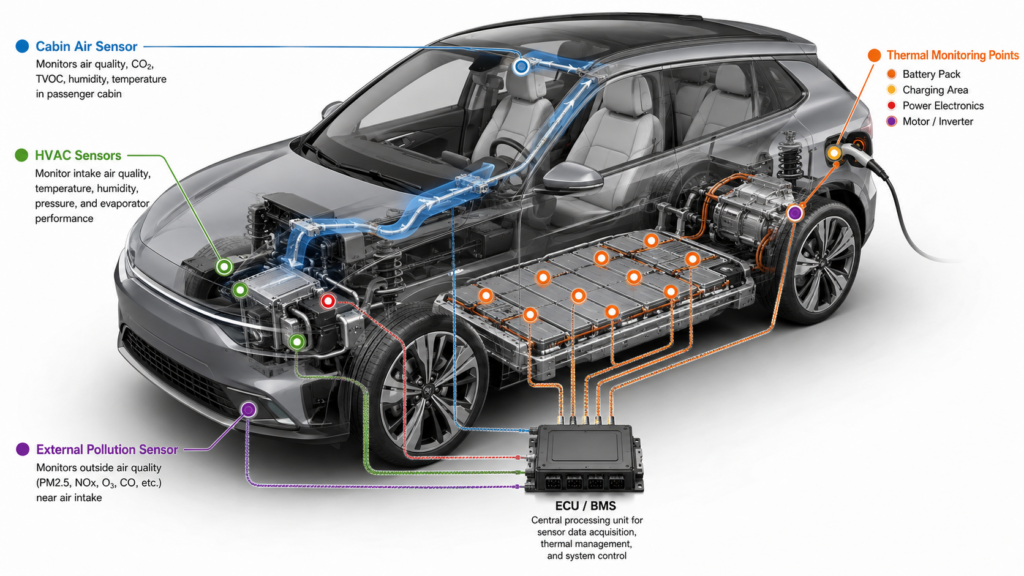
Figure: Smart vehicle sensor network
Why Automotive Sensing Is Becoming More Important
Automotive design is changing quickly.
Internal combustion vehicles need emissions control, cabin air quality, engine temperature monitoring, exhaust gas detection, and HVAC safety. Hybrid vehicles combine engine-related risks with high-voltage battery risks. Electric vehicles add large lithium-ion battery packs, fast charging, thermal management systems, heat pumps, and sealed battery enclosures.
At the same time, passengers expect more comfort, better safety, cleaner cabin air, and longer driving range.
This creates a simple truth:
A modern vehicle cannot be safe, efficient, and intelligent without advanced sensors.
- CO₂ sensors help monitor cabin air quality, passenger comfort, recirculation, and refrigerant leakage in vehicles using R744 CO₂ refrigerant.
- CO sensors help detect toxic carbon monoxide from exhaust leakage, combustion sources, garages, tunnels, or abnormal cabin contamination
- Temperature sensors help detect hotspots in battery packs, power electronics, motors, charging connectors, HVAC systems, and cabin zones.
- Gas sensors inside or near the battery pack help detect early off-gassing before thermal runaway becomes visible.
- Infrared or non-contact temperature sensors help measure temperatures on surfaces where direct contact is difficult.
Together, these sensors create a safety layer between invisible danger and human awareness.
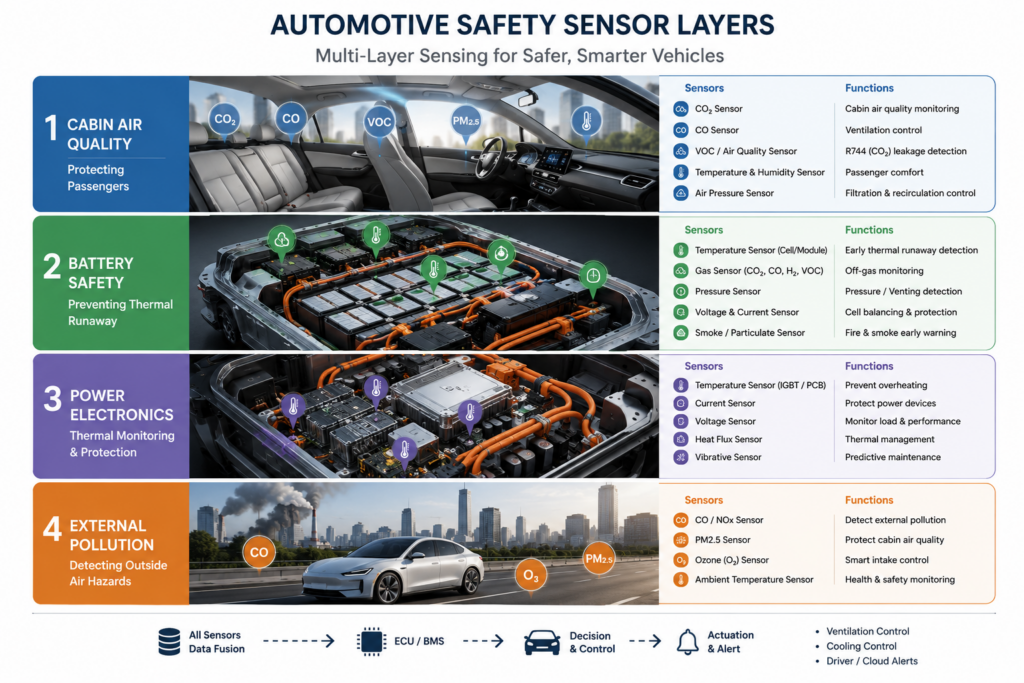
Figure: Automotive safety sensor layers
The Three Key Sensor Groups: CO₂, CO, and Temperature
1. CO₂ Sensors: Cabin Air Quality, R744 Leakage, and HVAC Efficiency
CO₂ is naturally produced by passengers breathing inside the cabin. When the HVAC system operates in recirculation mode for a long time, CO₂ concentration can rise. High CO₂ levels can make the cabin feel stuffy and may reduce alertness and comfort.
In modern vehicles, CO₂ monitoring is also becoming important because some automotive heat pump systems use R744, which is carbon dioxide refrigerant. If R744 leaks into the cabin, CO₂ concentration may rise quickly. A CO₂ sensor can help detect this condition and trigger ventilation or warning actions.
CO₂ sensor data can also help the HVAC system make smarter decisions:
- Increase fresh air when CO₂ is high
- Use recirculation when outside pollution is high
- Reduce HVAC energy consumption when cabin air is safe
- Improve passenger comfort
- Support air quality automation in premium vehicles
- Detect refrigerant leakage in R744-based systems
In electric vehicles, HVAC efficiency directly affects driving range. Smart CO₂ sensing helps balance comfort, safety, and energy savings.
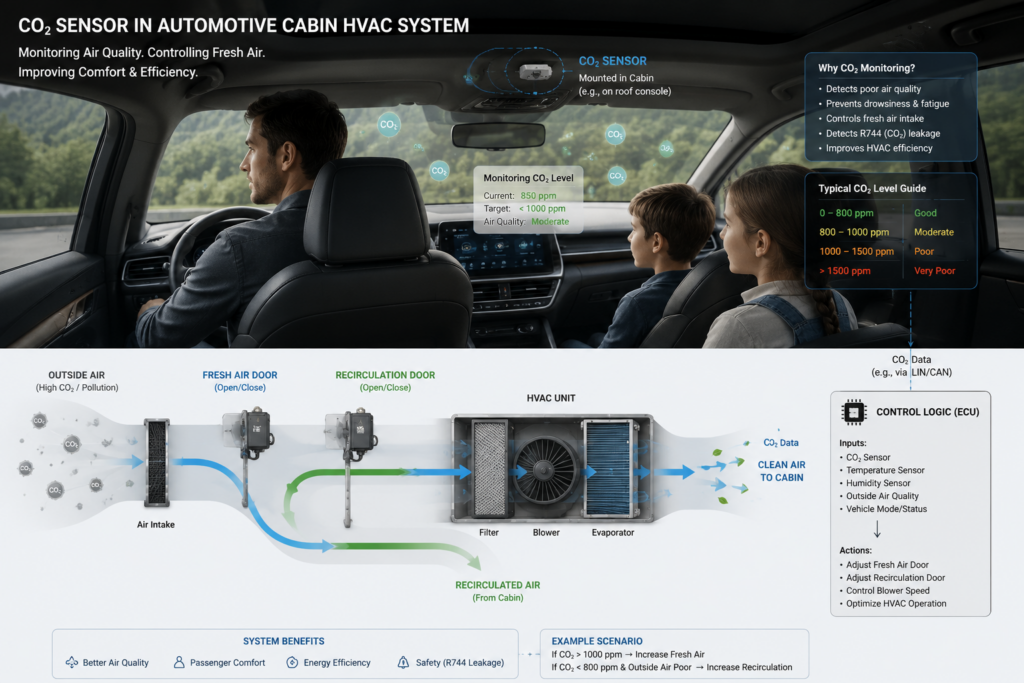
Figure: CO₂ sensor in automotive cabin HVAC system
2. CO Sensors: Carbon Monoxide Safety and Pollution Detection
Carbon monoxide is dangerous because it is invisible, odorless, and toxic. In combustion vehicles, CO may come from exhaust leakage, poor ventilation in garages, nearby traffic, tunnels, or external pollution entering the cabin.
Even in electric vehicles, CO monitoring can be useful in underground parking areas, traffic tunnels, enclosed spaces, fleet depots, and mixed vehicle environments where combustion vehicles operate nearby.
A CO sensor can help detect:
- Exhaust gas intrusion into the cabin
- Dangerous air in enclosed parking areas
- Poor ventilation around the vehicle
- Combustion-related pollution near the air intake
- Abnormal air quality around buses, trucks, taxis, and commercial fleets
When CO rises, the vehicle can automatically close external air intake, increase filtration, activate warning messages, or communicate with fleet monitoring systems.
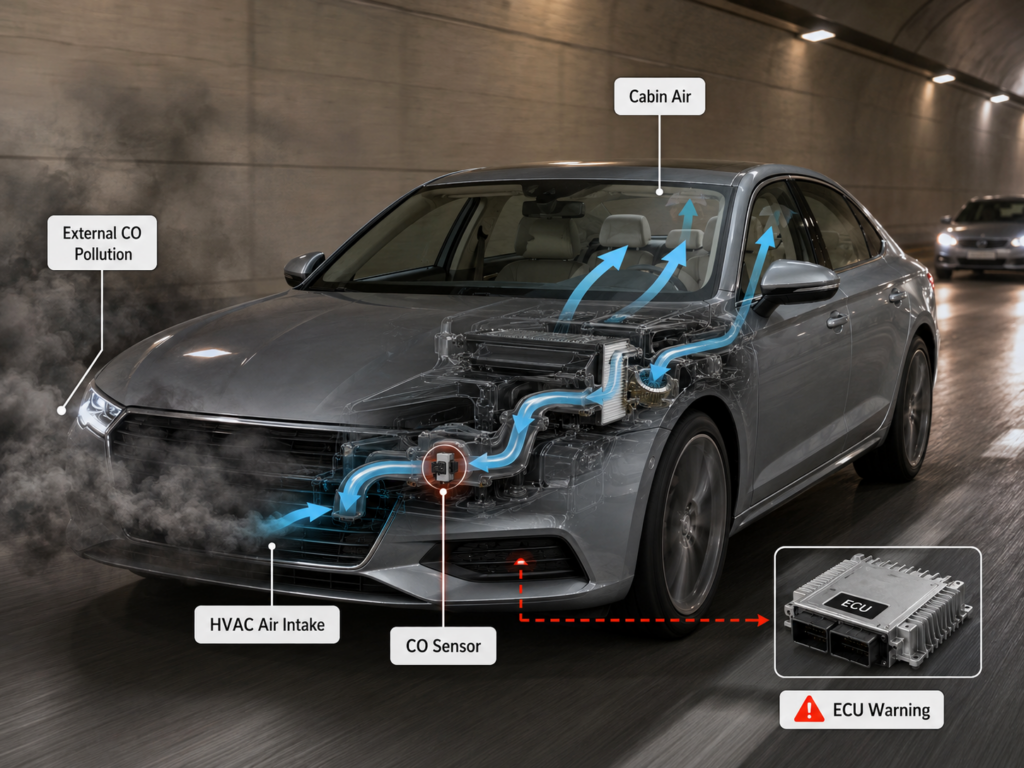
Figure: CO detection around the vehicle air intake and cabin
3. Temperature Sensors: Hotspots, Batteries, Motors, and Power Electronics
Temperature is one of the most important signals in automotive safety.
Every vehicle has many heat sources:
- Battery cells and modules
- Battery busbars and connectors
- Charging inlet
- On-board charger
- DC/DC converter
- Inverter
- Electric motor
- Power distribution unit
- Engine and exhaust components
- HVAC heat pump
- Coolant lines
- Brake system
- Cabin surfaces exposed to sunlight
In electric vehicles, temperature monitoring is especially critical because lithium-ion batteries must stay within a safe operating range. Local hotspots can indicate cell imbalance, poor cooling contact, internal short circuit, loose connection, overcurrent, coolant failure, or charging stress.
Traditional battery management systems often use contact temperature sensors such as NTC thermistors. These are reliable and cost-effective, but they may not capture every local hotspot. For higher safety, engineers can combine contact sensors, non-contact IR sensors, pressure sensors, and gas sensors.
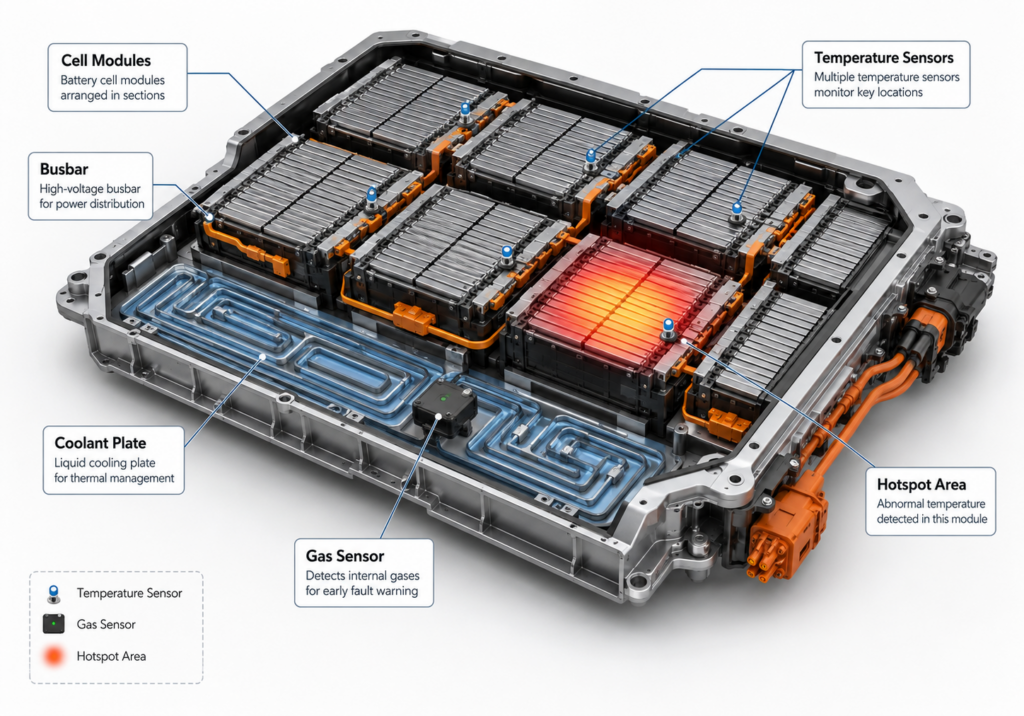
Figure: EV battery pack thermal monitoring zones
Sensor Technologies Used in Automotive Monitoring
Different sensor technologies are used depending on the gas, location, cost, size, and safety requirements.
NDIR CO₂ Sensors
NDIR sensors use infrared absorption to measure CO₂ concentration. They are selective and widely used for CO₂ measurement. Traditional NDIR modules can be larger, but newer designs are more compact and suitable for automotive integration.
Photoacoustic CO₂ Sensors
Photoacoustic CO₂ sensing uses absorbed infrared energy to create an acoustic signal. This technology can reduce sensor size and support compact automotive designs.
Electrochemical CO Sensors
Electrochemical sensors are commonly used for toxic gases such as carbon monoxide. They generate an electrical signal based on gas reaction at the electrode.
MEMS Gas Sensors
MEMS gas sensors can be compact, low-power, and suitable for embedded systems. Some are used for hydrogen, VOC, or air quality detection.
MOS Gas Sensors
Metal oxide semiconductor sensors can detect gases such as VOCs, hydrogen, CO, and hydrocarbons. They are useful for air quality and gas trend detection, but compensation and calibration are important.
NTC Thermistors
NTC thermistors are widely used for contact temperature monitoring in battery packs, motors, HVAC systems, and power electronics because they are low-cost and reliable.
Digital Temperature Sensors
Digital temperature sensors provide calibrated output and easy integration with electronic control units.
Infrared Non-Contact Temperature Sensors
IR temperature sensors measure surface temperature without touching the target. They are useful for monitoring rotating parts, moving surfaces, connectors, hot spots, or electrically sensitive areas.
PSD: Cost-Effective Automotive Sensor Solutions for Safer Vehicles
At PSD, we focus on providing reliable, compact, and cost-effective automotive sensor solutions for CO₂ monitoring, CO detection, temperature monitoring, gas detection, and thermal safety applications.
We understand that every customer has different requirements. Some need a simple temperature sensor module. Some need a compact CO₂ sensor for HVAC systems. Some need a CO sensor for air quality and pollution warning. Others need multi-gas battery safety modules for EV battery thermal runaway prediction.
What We Can Provide
- CO₂ sensor modules for cabin air quality and HVAC control
- CO sensor modules for pollution and toxic gas warning
- Temperature sensor modules for battery packs and power electronics
- Non-contact IR temperature sensor solutions for hotspot monitoring
- Multi-gas detection module development support
- Battery thermal runaway early-warning sensor solutions
- Calibration and compensation support
- OEM branding and private-label manufacturing
- ODM development for customer-specific automotive applications
For inquiries, please contact us