From a Silent Hotspot to a Server Room Alarm
At 2:17 a.m., everything in the AI data center looked normal.
The dashboard showed coolant flow within range. The cold plate loop was stable. Rack inlet temperature was acceptable. Fan speed was not unusual. The GPU cluster was still training a model, and no system-level thermal shutdown had been triggered.
But deep inside one high-density GPU server, one small area was getting hotter.
Not the whole rack.
Not the whole server.
Not even the full GPU board.
Just one small thermal zone near a heat sink edge, a connector, a voltage regulator, or a coolant tube surface. The problem was too local for a room sensor, too early for a GPU emergency shutdown, and too hidden for traditional monitoring.
This is where a miniature IR non-contact temperature sensor becomes important.
Instead of waiting for heat to spread, a small infrared temperature sensor can “look” at the surface temperature of critical components without touching them. It can monitor heat sinks, coolant pipes, power modules, airflow paths, fan outlets, cold plate surfaces, busbars, connectors, and other hard-to-reach areas inside AI servers and cooling systems.
In the age of AI servers, GPU clusters, and liquid-cooled data centers, cooling is no longer only about moving air or water. It is about seeing heat early, accurately, and continuously.
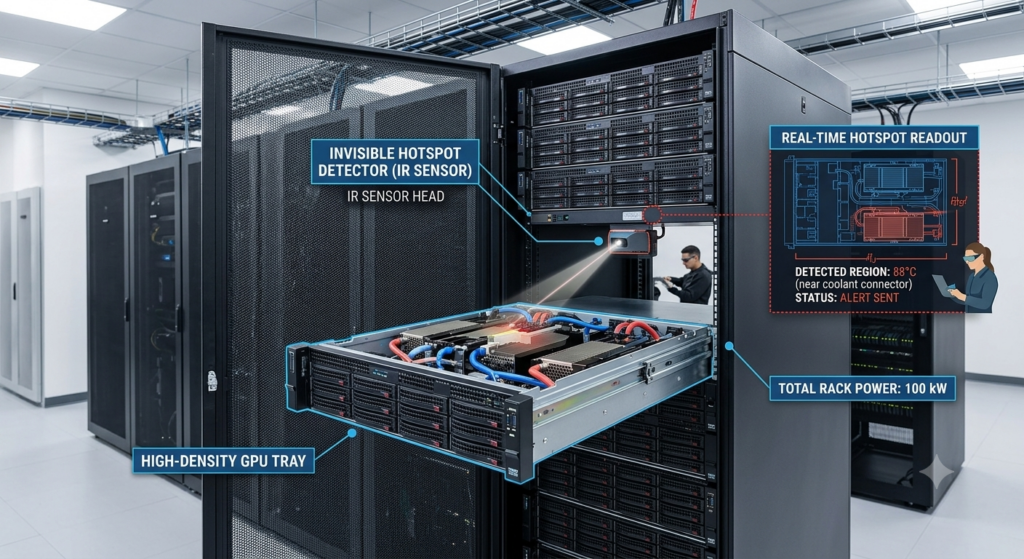
Figure: AI server rack with invisible hotspot detection
Why Temperature Monitoring Has Become Critical in AI Data Centers
Modern AI infrastructure is pushing data centers into a new thermal era.
Traditional enterprise servers were already sensitive to temperature, but AI GPU servers are different. They concentrate massive computing power in a small space. A rack can contain dozens of GPUs, high-speed interconnects, CPUs, memory, power modules, and liquid cooling hardware. In NVIDIA’s GB200 NVL72 architecture, for example, 72 Blackwell GPUs and 36 Grace CPUs are connected in a rack-scale liquid-cooled design.
That means the cooling system is not just a support system anymore. It is part of the performance system.
If cooling is weak, GPUs may throttle.
If a coolant loop is unstable, workload performance can drop.
If a connector overheats, the reliability risk increases.
If a fan path is blocked, a local hotspot may grow silently.
If liquid cooling leaks or loses performance, downtime can become expensive.
For AI data centers, even a small temperature problem can become a big business problem.
A few degrees of unexpected temperature rise can affect:
- GPU boost frequency and sustained performance
- Power efficiency
- Server reliability
- Component lifetime
- Fan and pump energy consumption
- Cooling control accuracy
- Maintenance planning
- Data center uptime
This is why local, miniature, fast, and non-contact temperature monitoring is becoming valuable.
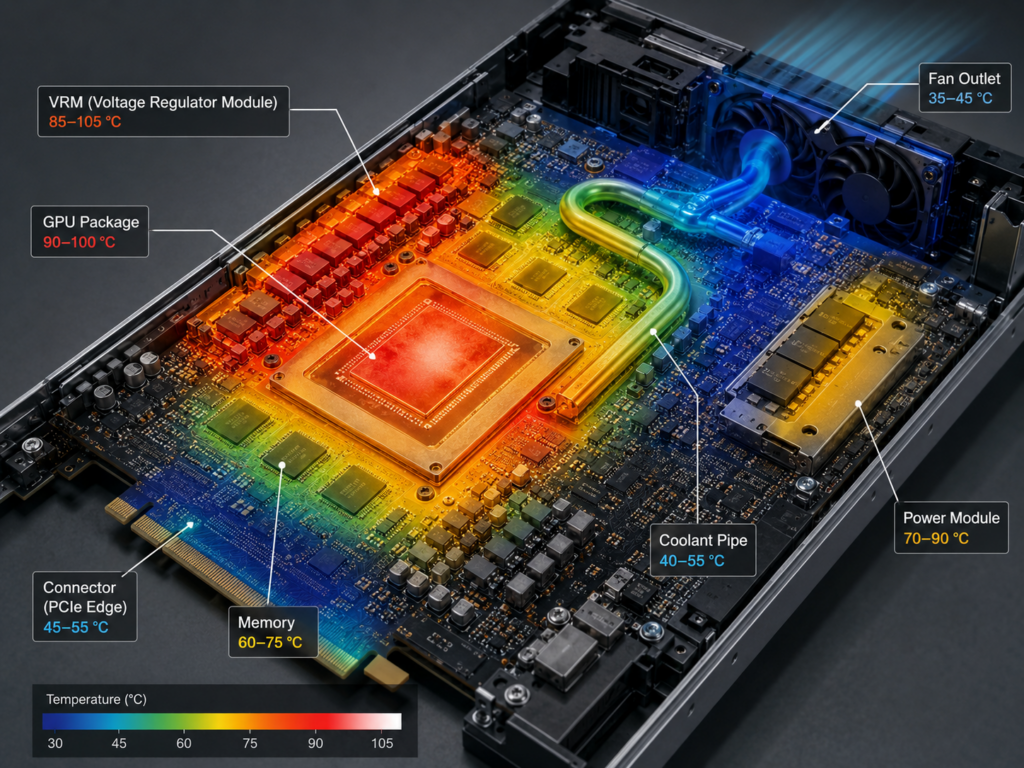
Figure: Heat map of GPU server thermal zones
What Is a Miniature IR Non-Contact Temperature Sensor?
A miniature IR non-contact temperature sensor measures the infrared radiation emitted by a surface and converts it into a temperature reading.
Unlike a thermistor, RTD, or contact probe, it does not need to touch the target surface. It can measure temperature from a short distance, through a designed optical window or opening, depending on the sensor and mechanical design.
Most miniature IR temperature sensors use thermopile technology. A thermopile converts incoming infrared energy into a small electrical signal. The sensor then uses internal or external signal processing to calculate object temperature.
In many modern sensors, calibration data, digital output, and compensation functions are included, making integration easier for embedded systems.
Common features include:
- Small SMD or module package
- Non-contact object temperature measurement
- Digital I²C output in many models
- Factory calibration
- Low power consumption
- Fast response
- Field-of-view options
- Suitable for compact embedded designs
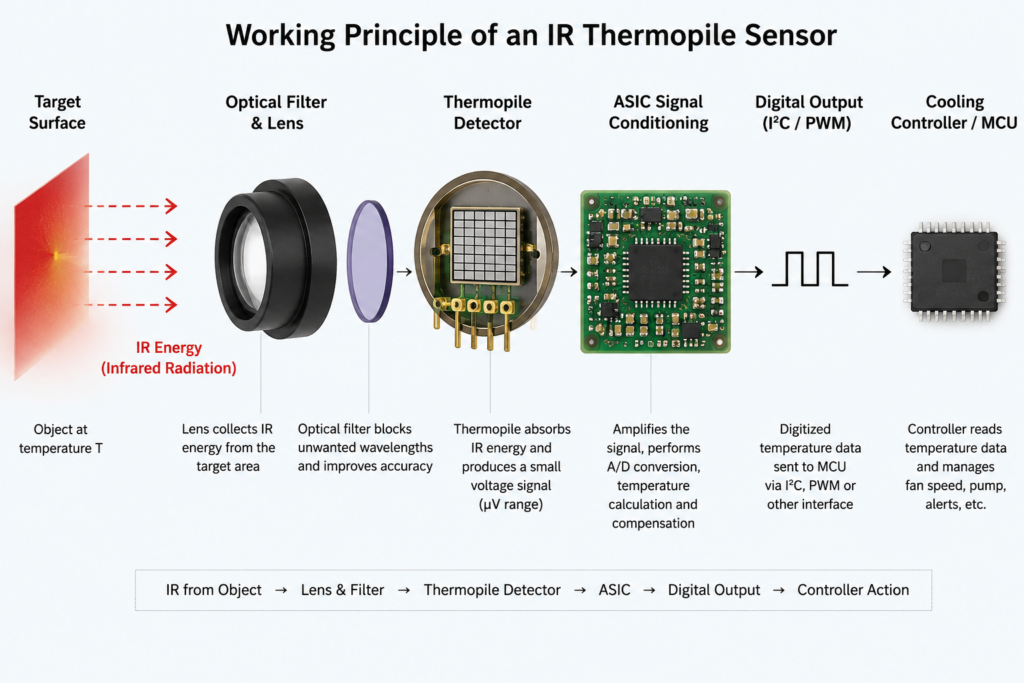
Figure: Basic working principle of an IR thermopile sensor
Important Design Considerations
A miniature IR sensor is powerful, but it must be designed correctly.
1. Field of View
The sensor sees a cone-shaped area, not a laser point. The target must fill the sensor’s field of view. If the sensor sees both the target and background, the reading may be mixed.
2. Distance to Target
Short distances are usually better for small targets. For compact server monitoring, the sensor may be placed a few millimeters to a few centimeters away from the target.
3. Emissivity
Different materials emit infrared energy differently. Matte black surfaces are easier to measure accurately than shiny metals. For metal surfaces, engineers may need coating, tape, calibration, or algorithm compensation.
4. Airflow and Thermal Shock
Fast airflow, nearby hot electronics, and local temperature gradients can affect sensor accuracy. The sensor itself should be thermally stable and placed carefully.
5. Optical Window
If the sensor is placed behind a window, the window material must be suitable for infrared transmission in the sensor’s wavelength band.
6. Calibration
Factory calibration is useful, but final product calibration may still be needed depending on target material, distance, housing, and airflow conditions.
7. Dust and Contamination
Data centers are cleaner than many industrial environments, but dust can still affect optical surfaces over time. Mechanical design should protect the sensor opening.
How to Select the Right Miniature IR Sensor for Cooling Systems
Before choosing the sensor, define the monitoring target.
For a small hotspot on a PCB
Choose a small field-of-view IR sensor and place it close to the target. Calibration is important.
For a coolant tube or cold plate
A single-point IR sensor is usually enough. Make sure the tube surface has a suitable emissivity or use a known surface finish.
For rack thermal mapping
Use multiple single-point sensors or a small IR array sensor.
For airflow and exhaust monitoring
Use IR sensors aimed at heat sink or duct surfaces, not directly into empty air, because IR sensors measure surfaces better than air.
For predictive maintenance
Choose a sensor with digital output, stable repeatability, and easy integration into a microcontroller or rack controller.
For OEM production
Choose based on size, supply stability, cost, calibration support, lifecycle, and customization options.
PSD Provide: Cost-Effective Miniature IR Non-Contact Temperature Sensor Solutions
At PSD, we focus on providing miniature IR non-contact temperature sensor solutions for customers who need reliable performance, compact size, and competitive pricing.
We understand that AI servers, GPU cooling systems, liquid cooling modules, industrial electronics, smart appliances, and embedded thermal monitoring products all have different requirements. Some customers need a standard sensor module. Others need a customized PCB, optical structure, housing, cable, connector, calibration method, or communication interface.
That is why PSD provides both ODM and OEM services.
What We Can Provide
- Miniature IR non-contact temperature sensor modules
- Compact PCB design for embedded integration
- Digital output options
- Custom field-of-view design support
- Sensor housing and mechanical structure support
- Calibration support based on the target surface and distance
- OEM branding and private-label production
- ODM development for customer-specific applications
Why Choose PSD
- Cost-effective sensor solutions
- Reliable supply support
- Flexible customization
- Engineering support for real product integration
- Suitable for AI server cooling, GPU cooling, liquid cooling, industrial monitoring, and smart devices
- ODM and OEM cooperation available
Temperature is information. Cooling failure is expensive. Early temperature visibility is cheaper.
Any questions related to miniature IR non-contact temperature sensors, please contact us